Why designers need Git in 2026.
Design is released, reviewed, and revised like product work. Version control is part of the craft — not optional literacy.
It starts with a quiet moment most designers recognize.
A product manager asks which version of the token set went live last Thursday. Someone opens a folder of files named final, final2, final_real, and use_this_one. A developer says the button looks wrong in production. The designer swears the Figma file is correct. Between those two truths sits a gap: not of taste, not of talent, but of shared memory.
That gap used to be manageable. In 2026, it is expensive.
The trail now has a name
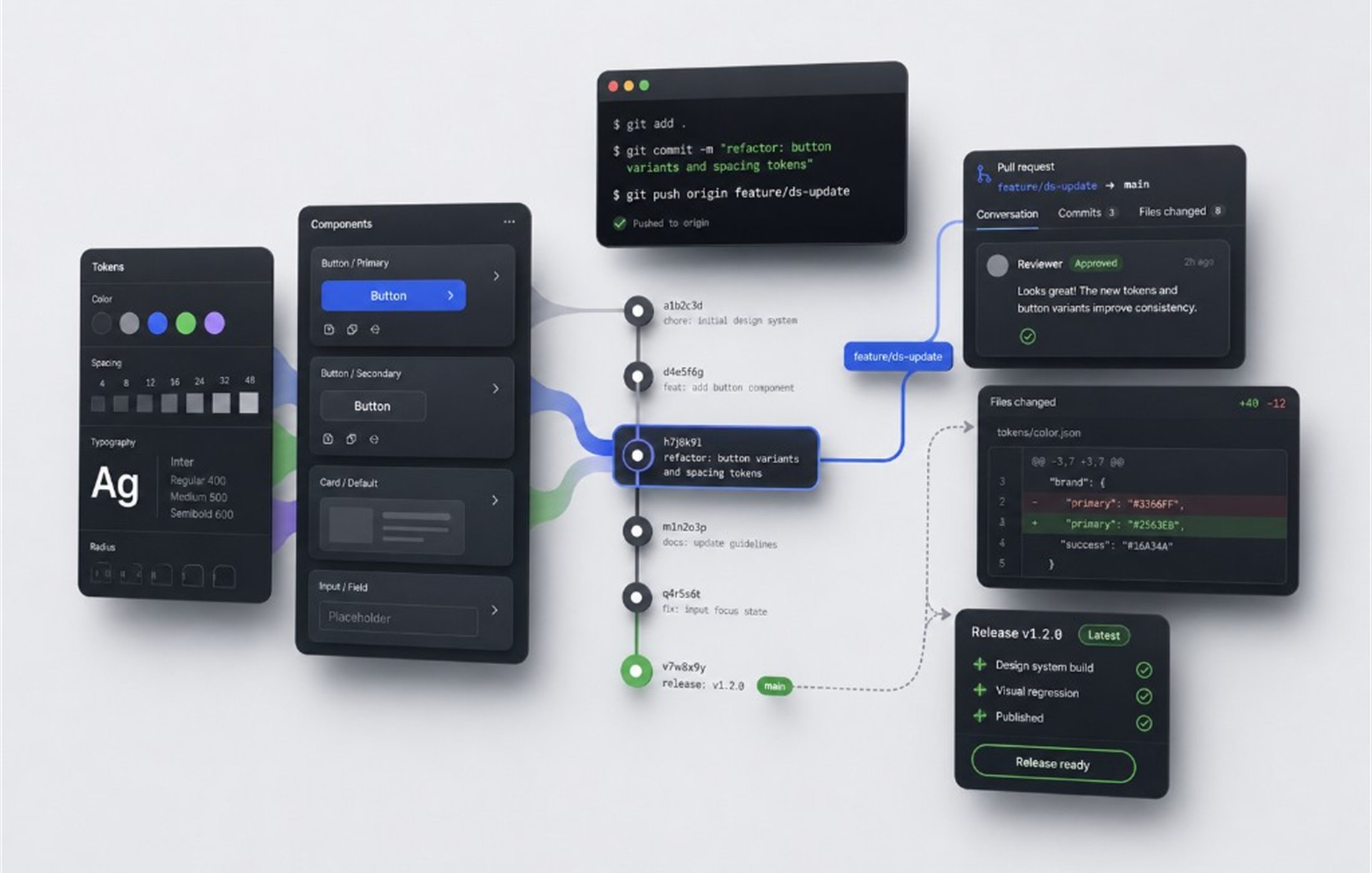
Design no longer ends when the file is “ready.” Tokens move into code. Prototypes live beside engineering work. Design systems evolve in public, commit by commit. Reviews happen in context, not in a separate conversation that someone later forgets to forward. The product changes through a trail of decisions, and that trail now has a name: version control.
Git is not glamorous. It will not make a portfolio look prettier. What it does is quieter and more valuable. It answers the questions that keep teams honest: what changed, who changed it, why it changed, and whether the change can be undone. Designers who cannot read that history depend on other people to narrate their own work. Designers who can read it stop waiting for translation.
This is not a call to become an engineer. It is a call to stay inside the room where the product actually moves.
Designers who cannot read that history depend on other people to narrate their own work. Designers who can read it stop waiting for translation.
Branches, reviews, and courtesy
Look at how modern teams collaborate. Parallel work is normal. A branch is no longer a technical curiosity; it is a safe place to try something without breaking the main line. A pull request is no longer only a code ritual; it is where design decisions meet implementation, where feedback lands on the change itself instead of drifting away in chat. A clear commit message is not bureaucracy. It is professional courtesy to your future self and to anyone who inherits the work after you.
You do not need the whole surface of Git. You need enough literacy to participate without asking someone else to narrate the work:
- Read a diff. See what actually changed before you argue about what should have.
- Write a commit message. One clear sentence about why, not a dump of what.
- Open or review a pull request. Put feedback on the change, not in a chat that expires.
- Find the Thursday that went live. Answer “what went live?” from the record, not from memory.
Speed without memory
The tools have already made the shift. Design systems are maintained like products. Tokens travel between design tools and repositories. Prototypes are versioned because iteration without history is just noise. AI has accelerated production, which means more artifacts, more revisions, and a sharper need for clean lineage. Speed without memory creates chaos. Git is how serious teams keep their memory intact.
The seat at the table
There is also a career truth underneath the workflow argument. The designers who thrive in 2026 are not only strong in craft. They are fluent in the operating system of product teams. They can own a change from intention to delivery. They can join a review without asking someone to “explain the Git part.” They reduce friction, earn trust, and take up a stronger seat at the table—not by shouting louder, but by speaking the language the work already uses.
So the case for Git literacy is simple, and it is not technical at its core. In a world where design is released, reviewed, and revised like product work, version control is part of the craft. Learn enough to participate with clarity. Leave the advanced edges for when you need them. What matters is this: stop living outside the history of your own work.
Because the next time someone asks what went live last Thursday, the strongest answer will not be a guess from a crowded folder. It will be a clean record—and the confidence to read it.