Ask what they did, not what they want.
Opinions are cheap and confidently given. Behaviour is expensive to fake, which is why it is the thing worth asking about.
The question that gets a useless answer
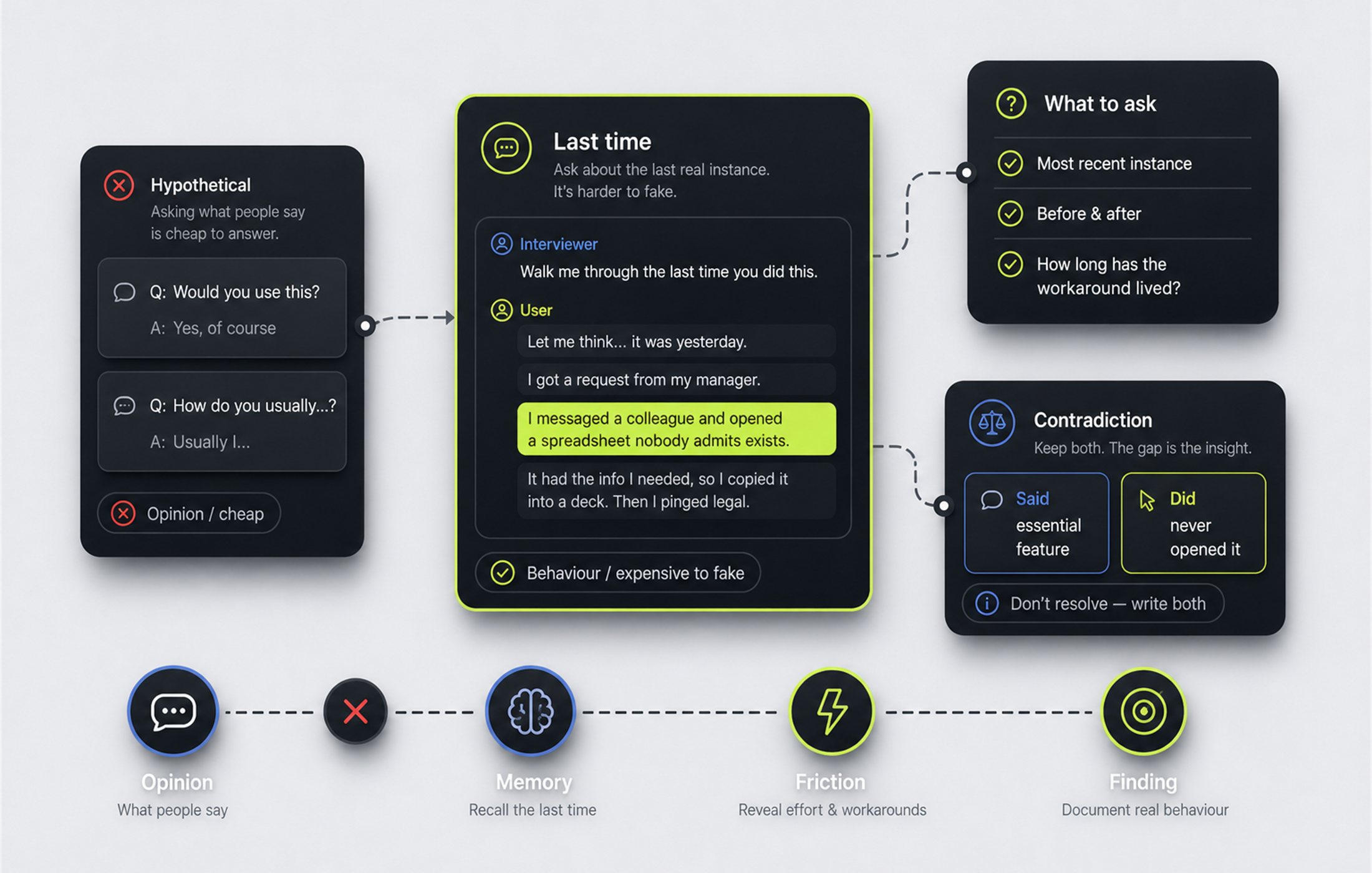
“Would you use this?” gets a yes. Not because people lie, but because the question asks them to predict their own future behaviour, in a situation they are not currently in, to someone who obviously hopes they say yes. Every part of that is unreliable — and the yes still ends up in a slide, labelled as evidence.
Usually is a summary they compose for you. Last time is a story with the friction still in it.
Last time, not usually
The repair is small: replace the hypothetical with a memory. Not “how do you usually handle this” but “walk me through the last time you did it.”
Usually is a summary the person composes for you: smoothed, rounded, quietly aspirational. Last time is a story with friction in it — the tab they had open, the colleague they messaged, the spreadsheet nobody admits exists.
- Ask for the most recent instance, never the typical one.
- Ask what happened immediately before and immediately after. The job rarely starts where your product does.
- When they describe a workaround, ask how long they have been doing it. A workaround with a two-year history is a requirement.
What to do with a contradiction
Sooner or later someone will tell you a feature is essential and then describe a month in which they never opened it. That contradiction is the most valuable thing in the transcript, and the instinct is to resolve it — to decide which half was true.
Don't. Write both halves down. Usually the stated need is real and the product simply is not where they go to meet it, which is a positioning finding wearing a feature request's clothes.