Put the human where the cost is.
Human-in-the-loop is not a checkbox on every step. It belongs where being wrong is expensive and hard to undo.
Confidence is the wrong axis
The default pattern for an AI feature is to gate on confidence: above some threshold the model acts, below it a person reviews. It is a tidy rule and it is usually the wrong one, because confidence measures how sure the model is, not how much it costs to be wrong.
A model can be perfectly confident about something irreversible, and quite unsure about something a person could undo in a second. Gating on confidence puts the human review in whichever place the model happens to find difficult, which has no relationship to where a human is actually needed.
Confidence tells you how sure the model is. It tells you nothing about what it costs to be wrong.
Map the cost of being wrong instead
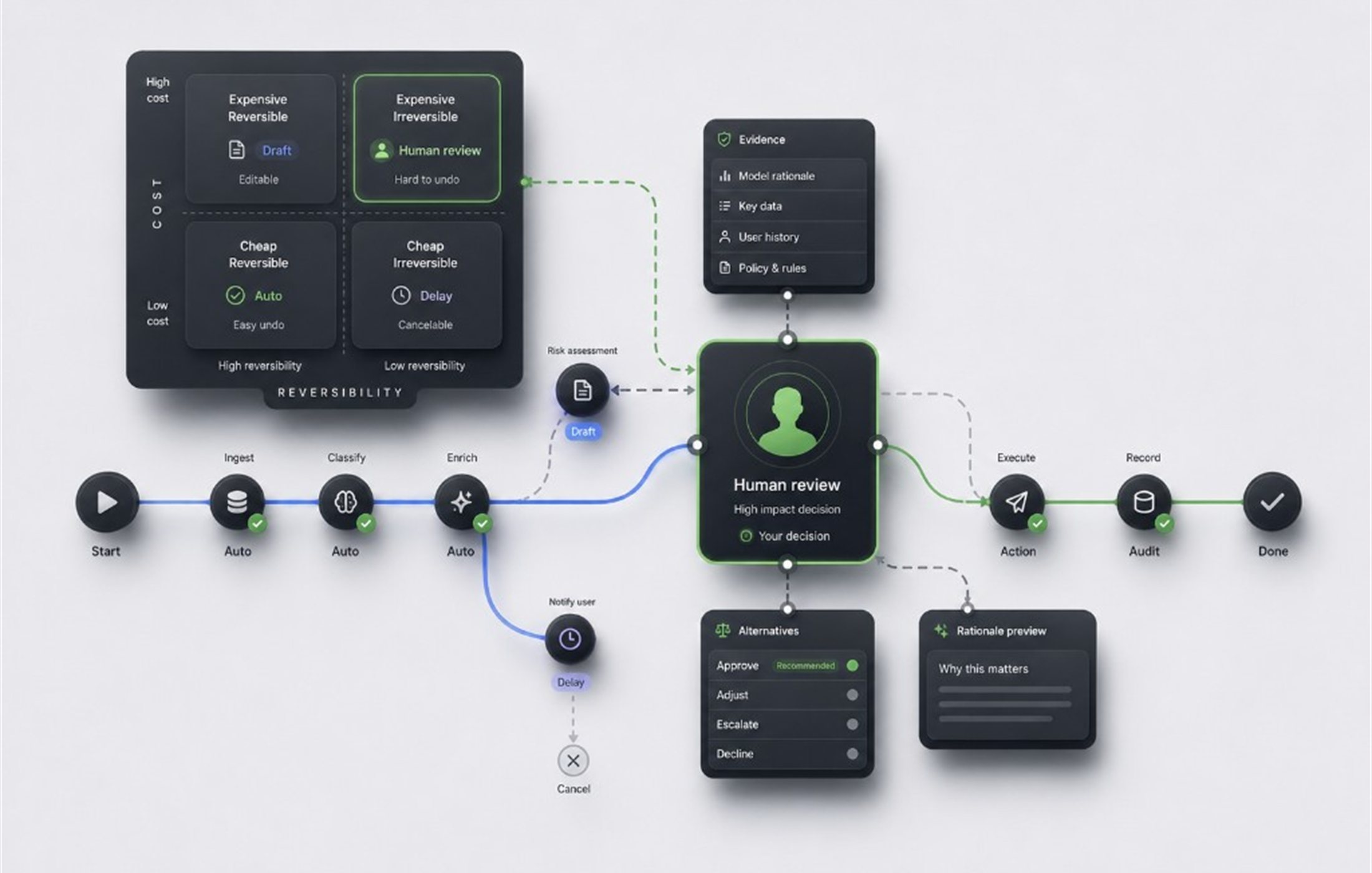
A more useful axis asks two questions of every step the model can take: what does a wrong answer cost, and how hard is it to undo? Four quadrants fall out of that, and each one wants a different interface.
- Cheap and reversible — let it act. Show what it did and make undo one click. Asking permission here only trains people to approve without reading.
- Cheap and irreversible — let it act, but delay. A short window where the action is visible and cancellable does more than a confirmation dialog.
- Expensive and reversible — let it draft. Editing is faster than authoring and more honest than reviewing a black box.
- Expensive and irreversible — the person decides, and the model's job is to make deciding cheaper: gather the evidence, show the alternatives, say what it would do and why.
Design the disagreement
The interesting screen is not the happy path. It is the one where the person disagrees with the model — and most AI features have no design for it at all. There is an Accept, and there is nothing else.
Rejecting should be as expressive as accepting: a way to say not this, and this instead. That is also where the product learns. A thumbs-down carries almost no information. An edit carries the answer attached.